Most articles about rubber roofs spend their time listing benefits. EPDM is durable, flexible, and cost-effective—you have probably read some version of that already. What those articles rarely explain is how the membrane is chosen, how seams are made, how the sheet is held down, how pipes and units are flashed, and where the water goes.
This guide focuses on those details. If you own or manage a commercial building and are weighing EPDM roofing in Sidney, MT, it will help you understand what a sound installation looks like, what questions to ask, and how to compare proposals beyond material claims.
Why Building Owners in Sidney Consider EPDM
Sidney is close to the North Dakota line, where buildings face cold winters, prairie winds, and seasonal freeze-thaw conditions. Shops, warehouses, agricultural facilities, and other commercial buildings often have low-slope roofs suited to properly designed single-ply systems.
EPDM, or ethylene propylene diene monomer, is a synthetic rubber membrane used on low-slope commercial roofs. Its low-temperature flexibility is useful in cold climates. But the material is only one part of the system. Roofs using the same membrane can perform differently depending on design, installation, exposure, and maintenance.
Installation Details vs. Material Claims: Know the Difference
Before getting into each component, it helps to separate material properties from installation requirements.
| Material Claim | Installation Detail |
|---|---|
| EPDM stays flexible in cold weather | Seams must be prepared and joined within the products’ application requirements |
| EPDM resists UV and ozone | Perimeter edges and terminations must be properly secured against wind |
| EPDM comes in wide sheets that can reduce field seams | The layout must suit the roof geometry, attachment system, and details |
| EPDM has a long track record | The assembly still needs effective drainage and maintenance |
| EPDM is repairable | Repairs and penetration flashing require compatible materials and preparation |
A material claim describes what the membrane can offer. Installation details help determine how the complete roof performs. Both deserve attention when comparing proposals.
1. Selecting the Membrane
Not all EPDM is the same product. A contractor should explain why a particular membrane is proposed for your building.
- Thickness: Common options include 45-, 60-, and 90-mil sheets. Thicker products provide more membrane material, but puncture resistance also depends on product construction and support beneath the sheet. Service traffic, walkway protection, warranty requirements, and budget should guide selection.
- Reinforced vs. non-reinforced: Non-reinforced membranes are used in approved adhered and ballasted systems. Reinforced products contain internal fabric reinforcement and are commonly specified for mechanically attached assemblies. Follow the selected manufacturer’s system requirements.
- Black vs. white: Black EPDM absorbs more sunlight, while white-surfaced products reflect more. Compare the building’s insulation, HVAC use, climate, and energy goals rather than assuming either color will lower annual costs. Roof color does not replace snow-load planning.
- Fire rating: Fire performance depends on the tested assembly, including the deck, insulation, cover board, and membrane. Ask which approved assembly the proposal specifies.
2. Seams: Where Most EPDM Leaks Start
Seams are important places to investigate when an EPDM roof leaks. Many modern systems use factory-applied or field-applied seam tape rather than older liquid splice-adhesive methods.
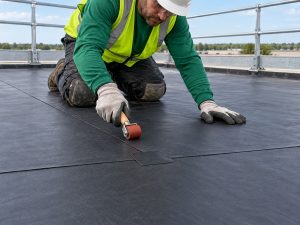
A properly made tape seam follows the selected system’s requirements:
- Cleaning and priming: Prepare the mating surfaces with approved materials and allow primer to reach the specified condition before joining.
- Correct overlap: Use the required sheet overlap and tape width.
- Rolling: Roll the seam with the specified tool and technique to establish full contact.
- T-joint detailing: Install required covers or flashing where layers intersect.
- Lap sealant: Apply it only where required by the manufacturer’s detail.
Cold-weather work deserves particular attention in Sidney. Primers, tapes, and adhesives have product-specific storage, handling, and application limits. Seaming over frost or moisture can compromise the bond. Ask how the proposed products will be handled during late-fall or early-spring work.
3. Attachment: How the Membrane Stays on the Roof
Wind is an important design consideration across eastern Montana and western North Dakota. Attachment affects wind resistance, cost, weight, and roof behavior. There are three common approaches.
Fully Adhered
The membrane is bonded to an approved substrate with compatible adhesive. Performance depends on the complete assembly, including substrate attachment, adhesive coverage, application conditions, and terminations. Adhesive requirements vary by product.
Mechanically Attached
Fasteners and plates or battens secure the membrane according to the specified system. Deck suitability, fastener resistance, spacing, and enhanced attachment at corners and perimeters all matter.
Ballasted
Loose-laid membrane is held in place by specified stone or pavers. The structure must support ballast and other required loads, including snow. Building height, wind exposure, and system limitations affect suitability.
Insulation and Cover Board
Suitable insulation and cover boards are secured beneath the membrane according to the approved assembly. Staggered insulation joints and appropriate layering can reduce heat loss through joints, while cover boards can provide firmer support and added protection. Wind resistance depends on every layer and its attachment.
4. Penetrations and Flashings
Pipes, vents, drains, curbs, and walls interrupt the roof surface. Each needs a compatible waterproof detail.
- Pipe penetrations: Suitable round pipes can receive pre-molded EPDM boots, with base and top seals installed according to the system details. Irregular conditions may need approved formable flashing.
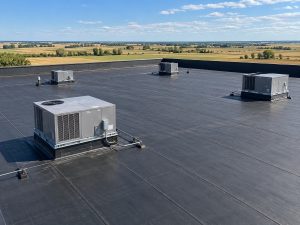
- Curbs and rooftop units: Membrane or flashing extends up the curb, with appropriate securement, corners, and terminations.
- Odd-shaped penetrations: Sealant pockets may be needed for certain configurations. Inspect and repair deteriorated filler according to the specified detail rather than simply topping it off.
- Walls and parapets: Flashing height, securement, and protection depend on the roof design and manufacturer’s requirements. Termination bars, counterflashing, or coping may form part of the detail.
- Roof edges: Perimeter metal and other edge components must follow the specified securement design.
Penetration spacing also matters. Closely grouped pipes and curbs can make proper flashing difficult. During reroofing, relocation or consolidation may be considered where practical, authorized, and coordinated with the relevant trades.
5. Drainage: Getting Water Off the Roof
A low-slope roof needs an effective path to drains, scuppers, or gutters.
- Tapered insulation: Can create slope where needed. The design must account for roof geometry, drainage, and applicable requirements.
- Crickets and saddles: Divert water around curbs and other obstructions.
- Drains and scuppers: Need suitable locations, capacity, and compatible membrane connections. Required overflow outlets provide an additional drainage route when primary drainage is obstructed.
- Ponding: Water remaining about 48 hours after rain warrants investigation, especially when persistent or extensive.
- Snow and ice: Winter conditions can obstruct drainage. Any proposed heating or other drainage measures need appropriate design and professional installation.
Questions to Ask Before You Sign a Contract
Use these questions to compare proposals for EPDM roofing in Sidney, MT:
- What membrane thickness and type are you proposing, and why?
- Which attachment method are you using, and how are perimeter and corner zones handled?
- How will seams be made in cold weather, and which product limits apply?
- How will each penetration and rooftop unit be flashed?
- Will drainage work address existing ponding?
- Is a manufacturer warranty available for the proposed system, and what does it cover?
- Will the existing roof be removed or recovered? If recovered, how will moisture, attachment, structural capacity, and compatibility be evaluated?
Clear answers and a defined written scope are more useful than general material claims.
EPDM Roofing Across Montana and North Dakota
Roof-specific design and manufacturer requirements matter across the region. If you manage properties outside Sidney, you may also find our information on EPDM roofing in Watford City, ND and EPDM roofing in Minot, ND helpful. Local exposure and building conditions should be considered for each project.
Talk to a Commercial Roofing Contractor in Sidney
The membrane gets much of the attention, but seams, attachment, flashing, and drainage are essential to the complete roof. If you are planning a new roof, replacement, or repairs, contact Hi-Line Commercial Roofing to discuss an assessment and EPDM system options for your Sidney, MT building.
Call (701) 621-0511 to discuss your project.
Frequently Asked Questions
1. How long does an EPDM roof last?
Many EPDM roofs provide decades of service, but longevity depends on the product, installation, weather exposure, drainage, service traffic, and maintenance. Regular attention to seams, flashing, and damage helps preserve performance.
2. How much does EPDM roofing cost for a commercial building?
Cost varies with roof size, membrane thickness, attachment, insulation, access, tear-off requirements, and penetrations. A roof assessment helps establish the scope for a written proposal.
3. Can EPDM be installed in cold weather?
Yes, when conditions meet the selected system’s requirements. Primers, tapes, and adhesives have product-specific handling and application limits. Some work may need to wait for suitable weather.
4. Is EPDM better than TPO for commercial roofs?
Neither is better for every building. EPDM is a rubber membrane known for low-temperature flexibility, while TPO commonly has a light-colored reflective surface and heat-welded seams. Compare complete assemblies against the building’s requirements, energy goals, and budget.
5. Can you walk on an EPDM roof?
EPDM roofs can accommodate limited maintenance traffic, but sharp objects and concentrated loads can damage them. Limit access to trained personnel and provide compatible walkway protection along frequent service routes.
6. Can an EPDM roof be repaired instead of replaced?
Often, localized punctures, seam problems, and flashing damage can be repaired with compatible materials and preparation. Widespread deterioration, extensive moisture, or damaged supporting materials may require larger repairs or replacement.